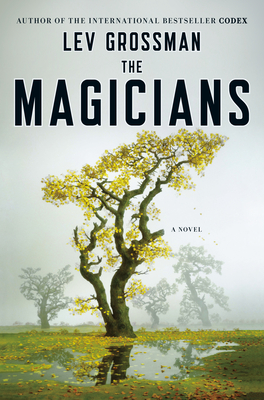
the blurb on the back of this ARC (plus the pretty, pretty cover) really sold me. magic in the real world? loosely disguised Narnia? nightmares and shocking truths? yes! well, except for the phrase "coming-of-age" -- that always makes me want to not read a book. too many high-school english class connotations. but i went ahead and read it anyway.
and i loved it! it's Harry Potter plus some Narnia plus sex, booze, lies, guilt, and other actual human emotions! the beautiful thing about the Harry Potter and Narnia series, and books like them, is that they are perfectly suited to reinforce moral codes: bad people are bad, good people are good (although they sometimes may make mistakes), and when you try and fight the good fight, you know exactly which side you should be fighting for. it's what makes them great reads for children (aside, of course, from the magic). but that's also the unrealistic thing about HP and Narnia (aside, of course, from the magic): good people aren't always good and bad people aren't always bad, and sometimes what appears to be the right side is absolutely not. and sometimes you don't even want to fight the good fight, sometimes you just want to go away and have a cocktail and see who comes out on top. and no, you don't necessarily want your 10-year-old to wrestle with the reality of these things. but if you're an adult (or teenager) reading Harry Potter, don't you find yourself wondering if Harry and Ron ever snuck up to the Astronomy Tower with something a bit stronger than butterbeer to get a buzz on? or if Hermione smuggled in some caffeine pills to help her stay awake during all that Time Twisting?
i definitely wondered, and so did Lev Grossman. THE MAGICIANS really, truly, does an excellent job imagining what we'd all be like if we could actually do magic and/or get to Narnia. sure, we could make pretty lights appear out of nowhere and levitate and shoot static charges at each other from across the room, but we would also cheat on our tests, sleep with the wrong person, make friends who are not good for us, have torturous childhoods, and in general continue to be dissatisfied with our lives. in other words, magic doesn't make us any less human or angsty or damaged. if you're like me, this thought makes you giddy with the sheer audacity of the premise. if it makes you cringe, then don't read this book.
so there's the love, now for the hate. yes, reality does often involve drinking. lots of teenagers (as much as we'd like to think otherwise), college students, and many, many adults drink. some more heavily than others. but everyone, and i mean EVERYONE, in THE MAGICIANS is constantly drinking, drunk, or hung-over and contemplating their next fix. always. all the time. every waking moment. some of it "sanctioned" by the magical Academy, and some of it "extracurricular." and these are supposed to be the brightest of the bright, the creative creme de la creme, collected together for the express purpose that they have talents no one else has. and ... they're all alcoholics? why, Lev Grossman, why? i understand that it's key to a specific character's development in the story. but all of them? all the time? now really. i knew a lot of very bright, very creative kids in high-school and college, and i can assure you that while they did indulge, the frat/sorority population was far more likely to behave the way Grossman's characters behave. unless he's going with the "tortured artist" cliche, but usually artists tend to be a bit older than 18 when they hit that point in their lives. i mean, Hemingway was probably a pretty tortured teen, but it took him years to work up to the level of debauchery that THE MAGICIANS' protagonists achieve.
i would really love to hear from the author about this -- if you're out there Googling yourself, please comment! i'm also curious to see if anyone else who has read the book feels the same way -- maybe i'm out of line here? unless and until those comments come, however, i will have to just continue to be torn. THE MAGICIANS pubs August '09.
my love/hate relationship with THE MAGICIANS
Sunday, March 22
fax from honduras
Friday, March 14tee hee! it's a bad joke, i know, but i can't control these impulses.
Telex from Cuba is not only a catchy title, but an ambitious first novel by Rachel Kushner. set in the 1950s and detailing the tumultuous transitions from Batista's presidency to Castro's coup, it bounces from narrator to narrator. children in the United Fruit-controlled towns Nicaro and Preston; an Eastern European prostitute at the Club Tokio; a French ex-Waffen arms dealer; pretty much every perspective except for that of a Cuban is represented. it's an interesting choice, and i think it works in this novel -- Kushner writes with great strength about foreign perspectives, foreign intervention, and their impact. there's a little unevenness of voice, because of this incredibly ambitious and intricate dialogue, but that's not uncommon in a first novel.
you won't learn anything new about Castro (well, maybe you will, not all of us were history majors), but you will be drawn into the web that Kushner weaves, and sad when the story has spun itself out. get this one in hardback -- i foresee great things from her, and you'll want a first edition!
formula one is not nascar
Sunday, February 3one of the many things that happens at bookseller conferences is, reps from publishers get to pitch their favorite new titles. generally they have no more than eight or so minutes to get through a list that can be as long as ten or twelve titles, so they've got only a very little time to get your attention.
The Art of Racing in the Rain was one that definitely got my attention. the rep said something about "NASCAR and Buddhism" and then "narrated by a dog." you better believe that got my attention! so, at the author reception that night, i found Garth Stein and told him as much: "your rep said it was about Buddhism, NASCAR, and a dog, and i had to meet the author who could write that book."
the poor guy. he sighed and said "i'm going to have to talk to those Harper people. it's Formula One, not NASCAR!"
at the time, i nodded sympathetically, not having a clue what the difference might be.
folks, the highest praise i can give to this book is that i now care about that difference. Racing in the Rain is an incredible piece of work, one that i will be handselling with gusto. Enzo, our canine narrator, is the perfect medium to tell this story: the story of Denny, a man with talent (at Formula One. not NASCAR!) who faces not "insurmountable odds", but rather every day odds taken up a notch -- something that makes him that much more of a hero. his family saga is heartbreaking in its commonality, and his custody battle for his daughter, while more extreme than many, is by no means unusual in its cruelty, its hopelessness, and its redemption.
the characters are perfectly drawn, seen in all their glory and misery by faithful Enzo, who may be part terrier and is definitely part sage. the backdrop of Formula One is made absolutely fascinating with the minutiae of racing greats, tactics, terms, and Zen-like philosophy (it's Zen, not Buddhism!). Denny's daughter Zoe, especially, is the light at the end of the tunnel -- a perfectly normal, perfectly lovable child. and the zebra ... well, for that, you'll have to read the book yourself.
The Art of Racing in the Rain comes out in May. run, do not walk, to your nearest indie bookstore and buy yourself the hardback. a first edition will, mark my words, be worth something one of these days!
yeehaw
Monday, December 17i like my fiction the same way i like my water -- with a little zing to it. (don't ask me why, i am constitutionally incapable of drinking water that doesn't have a squirt of lemon or lime juice in it. i have no idea. probably has its roots in some repressed childhood trauma involving, umm, water.) probably because of that, i can't think of any books to compare my latest read to.
The Last Cowgirl, by Jana Richman, is definitely what i would call Western Fiction. i'm not sure if that subgenre is legally recognized, but it should be. there's lots of it out there. and big names too, like Wallace Stegner and William Kittredge. at least, big names here in the wild west. these are books that sigh out dust and tumbleweeds when you open them, and are accompanied by the chorus of cicadas and the yipping of coyotes (pronounced KAY-oats). i suppose that some of Barbara Kingsolver's opus could qualify as well -- i'm thinking here of works like Bean Trees, Animal Dreams, and Pigs in Heaven.
but those three books are what i call (with great fondness and love) advanced chick lit. The Last Cowgirl, despite what you might think from the title, is anything but. i can't think of a single moment that would qualify as girlie. there are deep, emotional, loving, desperate, depressed, and insightful moments, but definitely no girlie.
that said, this is a good book. it's her first novel (i'm intensely curious now about Riding in the Shadows of Saints, which would fit into the Non-Fiction counterpart to Western Fiction) and, in my opinion, started out a little bit rough. but once it got rolling, i really did want to know how it would end.
Last Cowgirl has great moments, and some very even-handed thoughts about environmentalism, ranching, and the military's impact on both. instead of zing, it has solidity and weight. and dust, and cows, and nerve gas, jack Mormons, a funeral, an old flame, horses, evil gossipy highschool ex-bestfriends, and a very important zucchini plant.
in summation, city-slickers beware! this one will get you dirty.
happy endings
Monday, November 26imagine your favorite fairy tale -- you know the one, that you've had read to you a million times and then read to yourself a million more -- and imagine discovering it for the first time. imagine that no one but you has ever read it, and that the only way they ever will is if you share it with them. imagine that you work for weeks, trying to find the right way to share it.
now imagine a book that seems to write itself as you read it, a book that feels its way through the story and learns its plot only as you turn the page. a book that has narratives that swirl around each other, touching occasionally only to draw away, until they meet at the end in a thundering crescendo.
now imagine that both those things, your favorite fairy tale and a book that writes itself, are in fact the same thing. meet The Translation of Dr. Apelles, by David Treuer.
if all of the above irritates you, because it doesn't tell you anything about the plot or who the characters are or what they are like, then this book is probably not for you. it shifts around, it changes direction mid-scene, it will not be still. and neither will the characters, for the most part. but unlike many other novels that call themselves things like "experimental" and "post-modern", this novel has no pretensions. it is so simple, and so enchanting.
normally i would try to tell you about other books, similar books. but in this case, i really can't. luckily, The Translation of Dr. Apelles is already out in hardcover. if you can't wait, you can buy it now. if you can, it's out in February 08.
either way, this book is a treasure.
pigeons and power
Sunday, November 4i started it this morning. or last night, i'm not entirely sure. but i finished it today, and i know that either way, i read it really fast.
it's only 251 pages. it's thin for an advance reader. the cover is just white, with an illustrated pigeon in profile, squarely in the middle. the spine is blue. when i first pulled it out of the ARC box, i thought it was another of those histories of a specific thing, until i remembered that someone's already done pigeons.
then i looked at the title. The Invention of Everything Else. Samantha Hunt. i'll take it home, i thought. why not.
it's simply wonderful.
i'd never heard of her before, though The Seas does sound vaguely familiar. judging by The Invention, she's a terrific writer. it's a history, but it's not. it's a love story, or it's almost a love story, or it's two love stories, one finished and one just beginning. it's a biography, but only sort of. there are a lot of pigeons involved. electrical currents, invisible waves of energy. edison and tesla, new york before and after electricity, time travel (possibly? not at all? most definitely?), mark twain, and tunnels buried beneath now-old-but-then-new hotels.
you must read it. the only book i can think of that comes close is Dreamland, by Kevin Baker. come to think of it, they belong side by side on a shelf. on my shelf. right next to Suskind's The Pigeon. i'll go do that right now...
the gothic and the girlie
Saturday, November 3at one of the other bookstores i worked for, "chick lit" was a dirty phrase. the manager, normally a mild-mannered, cheerful, and all around wonderful woman, would shoot you a look full of daggers if you uttered it in front of her. "fluff" would also get you a look, but minus the daggers (probably because it's not gender specific).
but let's be honest. there are some books that, by their nature, appeal more to women than to men. and vice versa. aforementioned manager even instituted a shelving policy to highlight this -- there was a section called "rough reads" that was the male equivalent to the Unutterable Phrase. and those books are not all "fluff," either.
my case in point, when i argue about this with people, is usually Barbara Kingsolver. if you've worked books, you know that the customers who buy these books are almost invariably female. but you'd be hardpressed to find anyone who would call her works fluffy. she tackles serious issues with complex, articulate, and stunning prose. if you don't believe me, pick up a copy of The Poisonwood Bible or Prodigal Summer.
which brings me to my latest read: The Monsters of Templeton, by Lauren Groff. it's Barbara Kingsolver meets Charlotte Bronte. what does that mean? it means that this novel is a gothic family history, told by a narrator just like Taylor from The Bean Trees. The Monsters of Templeton brings girlie to gothic with stunning effect. which means, of course, that i absolutely loved it.
it's funny that i'd find this book so soon after reading The Thirteenth Tale for the first time (but as i mentioned before these things just seem to happen). this was another modern tribute to the gothic mystery. as i read it, i couldn't help but think about it as if Edgar Allen Poe had concocted a family history for A.S. Byatt, which was then revealed by a quietly endearing mouse of a biographer. And then, to top it all off, I picked up Mary Modern, which is gothic by feel if not by plot (who ever thought cloning would feel gothic?) and that's a compliment. Large house with hidden passageways, chronologically displaced characters wandering around, cloning, a rabid preacher -- Camille De Angelis has written a bizarre and fascinating book.
so, while you're waiting for The Monsters of Templeton to hit the shelves (February 2008), you have some books to while away the time.
reading india
Monday, October 29i didn't do it on purpose. these things just seem to happen. every now and then these huge boxes, filled with Advance Reader Copies (ARCs), arrive at our door. it's true, i'm attracted to bright colors. and alliteration. and really good fonts (i'll let you in on a secret -- i am
one of those booksellers who has to battle not to judge a book by its cover). is that why i went home with two books that turned out to be excellent companion pieces? probably not. you wouldn't have known from the titles, anyway. i mean, sure, Breathless in Bombay kind of clues you in to the contents. and while Unaccustomed Earth doesn't necessarily scream "India", Jhumpa Lahiri should be a dead giveaway. but that escaped my attention until yesterday.
i've been reading Breathless in Bombay, by Murzban Shroff, for two weeks now. it's not that it's a long book, it's because it's chock full of short stories that require a little reflection after finishing. so i haven't quite completed the book yet, but each story has successively lodged in my brain. they all take place (you guessed it) in Bombay, span social and caste levels, and are wonderful. the writing is simple, rich in description, and incredibly evocative.
and then, just this past week, i picked up Jhumpa Lahiri's Unaccustomed Earth, also a collection of short stories, about Indian immigrants in America. this one, i've already finished. it sucked me in and wouldn't let me go. The first half of the book is, characteristic of her writing, poignant and thoughtful, and really good. the latter half, a set of three stories that are linked by their main characters, is fantastic. i love story sets like these -- Ursula Le Guin
(http://www.sfsite.com/03a
when I put Unaccustomed Earth down yesterday, it struck me that i had just gone on a journey. i had started in Bombay, immersed in Shroff's portrayal of the sights and sounds and smells of India, and then traveled to America, far from that heat and bustle and life, to Lahiri's cold coasts, displacement, generation gaps, and struggle to belong. it made me wish I'd read them both with a friend or book group, to explore the transitions, the similarities and differences, not just of the stories but of the writers and their perspective.
Breathless in Bombay will be out in February 2008, and Unaccustomed Earth in April 2008.
